Blog by VT Agrofoods
Understanding IPM Spices: Why Buyers Are Paying Attention
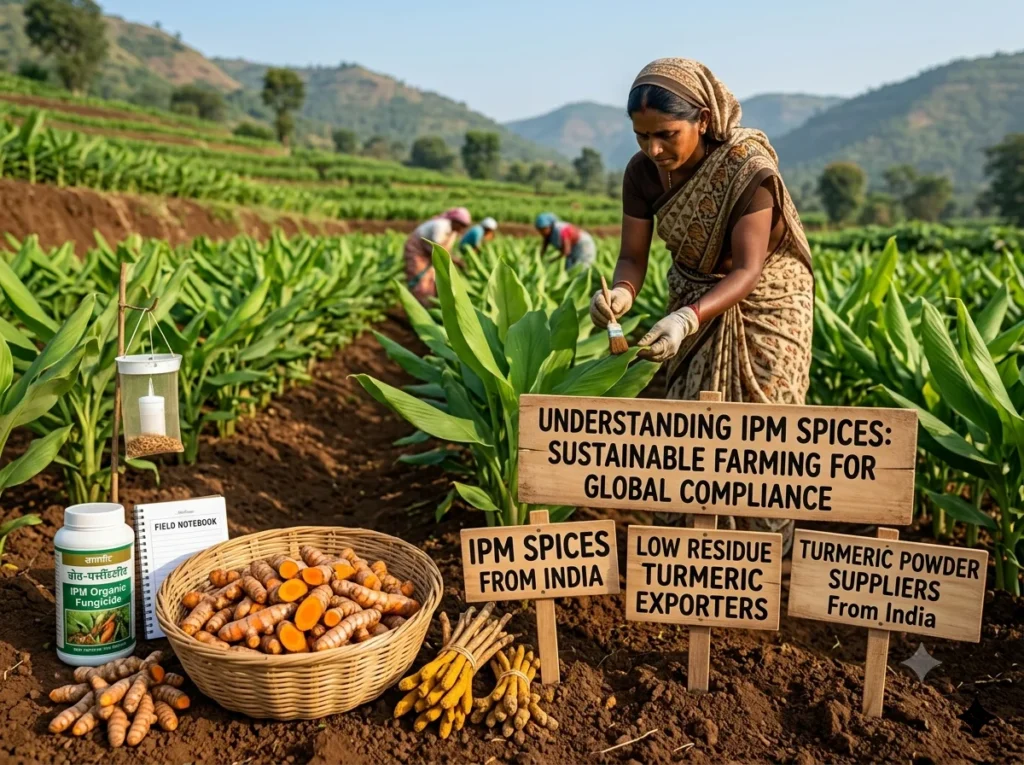
The global spice trade is undergoing a fundamental transformation. For decades, international bulk procurement was primarily driven by price competitiveness, basic visual grade, color intensity, and volatile oil content. However, as international regulatory authorities tighten import regulations and end-consumers demand greater transparency, pricing alone is no longer the decisive factor in procurement decisions. Today, global buyers prioritize compliance-focused sourcing requirements, food safety guarantees, and complete supply chain traceability. At the forefront of this shift are IPM (Integrated Pest Management) spices, with low-residue turmeric emerging as one of the most critical and sought-after commodity categories for international trade.
For business owners, importers, and food processors navigating complex international trade policies, transitioning to IPM-grade commodities is no longer an optional sustainability perk—it is a core risk-mitigation strategy. Leading ipm turmeric exporters have documented a clear, sustained increase in inquiries from overseas buyers seeking verified, clean-label raw materials that satisfy stringent statutory limits without sacrificing commercial scalability.
Get in Touch :-
Integrated Pest Management (IPM) is a comprehensive, eco-friendly agricultural framework designed to prevent crop damage while keeping chemical inputs to an absolute minimum. Rather than relying on calendar-based synthetic chemical sprays, IPM combines biological, mechanical, physical, and cultural practices to keep pest populations below the Economic Injury Level (EIL).
The operational core of IPM farming relies on four strategic pillars:
Biological Control: Encouraging or introducing natural predators, beneficial insects, and bio-fungicides (such as Trichoderma or Pseudomonas) to control soil-borne pathogens and field pests naturally.
Cultural & Mechanical Practices: Utilizing crop rotation, deep summer plowing, trap crops, and physical pest barriers to disrupt insect breeding cycles before infestations start.
Field Monitoring & Trapping: Utilizing pheromone traps, sticky sheets, and regular field scouting to monitor pest density accurately, ensuring action is taken only when necessary.
Judicious Chemical Use (Last Resort): Applying approved, target-specific chemicals only when non-chemical interventions prove insufficient, strictly adhering to pre-harvest intervals (PHI).
By shifting agricultural practices from reactive chemical overuse to proactive ecosystem management, IPM farming yields crops that retain their inherent aromatic and bioactive qualities while remaining virtually free from hazardous agrochemical residues.
What is IPM Farming in Spices?
Lower Residue Risks & Global MRL Compliance
The overwhelming commercial catalyst driving demand for IPM spices is the global crackdown on Maximum Residue Limits (MRLs). An MRL represents the highest legal level of a pesticide residue permitted in food or feed commodities. Regulatory bodies across major importing regions continuously update and lower these thresholds based on evolving toxicological assessments.
European Union (EU) MRL Mandates: The EU enforces some of the world’s most aggressive pesticide regulations under Regulation (EC) No 396/2005. EU border inspection posts routinely test incoming spice shipments for hundreds of active chemical compounds—including banned substances like ethylene oxide (EtO), chlorpyrifos, and triazophos. Over-the-limit findings result in instant container rejections, mandatory border destruction, public notifications on food safety portals, and severe reputation damage for the importing entity.
Clean-Label & Risk Mitigation: Conventional spice farming poses high commercial risks due to unpredictable pesticide residues. IPM protocols control inputs at the farm level, ensuring multi-residue pesticide test screens return compliant or non-detectable results, effectively insulating importers from financial losses.
To maintain unbroken supply chains and avoid port rejections, global buyers rely on established low residue turmeric exporters who provide comprehensive lab test validations from accredited laboratories prior to shipment dispatch.
Key Applications of Low-Residue Turmeric
Why Buyers in Europe and MENA Seek Low-Residue Turmeric
Because low-residue IPM turmeric offers superior purity alongside high curcumin potency, it has become the standard ingredient across several high-value industries:
| Industry Sector | Primary Usage | Key Technical Requirement |
| Food Processing & Spice Blending | Formulating curry powders, spice mixes, sauces, and ready-to-eat meals. | Strict MRL compliance, clean aroma, consistent coloring strength, and low micro-counts. |
| Nutraceuticals & Dietary Supplements | High-purity extraction of curcuminoids for dietary capsules, tablets, and health tonics. | High natural curcumin content (3%–5%+) with non-detectable solvent and pesticide residues. |
| Cosmetics & Personal Care | Formulating natural skincare creams, face masks, soaps, and herbal cosmetics. | Total absence of harsh chemical residues that cause skin irritation or fail safety audits. |
| Clean-Label Beverages & Retail | Premium packed retail spices, functional beverages, and turmeric tea blends. | Direct-to-consumer purity guarantees and farm-level origin traceability. |
The European Market Dynamic
European buyers operate under intense regulatory scrutiny alongside strong consumer demand for clean-label, ethically produced foods. Importers must comply with rigorous European Food Safety Authority (EFSA) standards, where single-digit parts-per-billion (ppb) pesticide trace levels can trigger an administrative recall. Furthermore, European consumers actively look for products with verifiable sustainability credentials. For European spice houses, IPM turmeric provides the exact balance needed: food safety compliance equivalent to organic standards, backed by the supply volume necessary for mass industrial processing.
The MENA Market Dynamic
The Middle East & North Africa (MENA) region—spearheaded by countries across the Gulf Cooperation Council (GCC)—is witnessing a massive expansion in its food manufacturing, re-export, and hospitality sectors. Regulatory authorities such as Saudi Arabia’s SFDA (Saudi Food and Drug Authority) and UAE food safety boards have significantly upgraded their import compliance frameworks, aligning closely with international Codex Alimentarius standards. Importers in major trade hubs like Dubai require low-residue raw materials to fulfill domestic consumption needs and facilitate seamless re-exporting to secondary markets across Africa and Central Asia without customs friction.
Supply Chain Traceability and Quality Assurance
Securing high-grade IPM turmeric requires deep integration across the agricultural value chain. Traceability is the backbone of IPM sourcing—every commercial bag must be traceable back to specific farm clusters, harvest dates, and agricultural input logs.
A typical quality assurance workflow for IPM turmeric includes:
Contract Farming & Farmer Training: Agronomists train farmer groups directly on IPM protocols, providing eco-friendly biopesticides and monitoring tools.
Pre-Harvest Field Testing: Soil and leaf samples undergo preliminary laboratory screening before harvesting begins to verify zero prohibited chemical usage.
Post-Harvest Handling: Turmeric rhizomes are cleaned, cured, dried, and polished in hygienic, controlled facilities to prevent cross-contamination and mold formation.
Comprehensive CoA Generation: Final export lots undergo multi-residue screening (testing for 200+ active pesticide molecules), heavy metal analysis, aflatoxin tests, and microbiological checks in NABL / ISO-accredited laboratories.
The Strategic Advantage of Indian Sourcing
India is the undisputed global leader in spice production, accounting for more than 70% of the world’s turmeric supply. The country possesses ideal agro-climatic zones, rich traditional farming knowledge, and an extensive network of specialized agricultural research institutions dedicated to spice enhancement.
Indian origin turmeric is globally renowned for its high curcumin content, vibrant deep-orange pigmentation, and rich essential oil profile. To meet the stringent expectations of international buyers, premier turmeric powder suppliers From India are investing heavily in backward integration programs. By working directly with agricultural cooperatives, establishing field-level testing protocols, and operating modern processing machinery, Indian suppliers deliver fully compliant, lab-certified IPM turmeric tailored to meet the exacting standards of European, American, and MENA destinations.
Securing Your Clean Spice Supply
As international food safety regulations continue to tighten, the global shift toward low-residue ingredients will only accelerate. Sourcing IPM spices is no longer just a trend—it is the modern benchmark for sustainable, risk-free international trade. For global importers, food processors, and distributors, establishing long-term partnerships with certified IPM suppliers ensures consistent product quality, protects brand reputation, and guarantees seamless clearance across international borders.
What Happens When a Spice Crop Is Smaller Than Expected?

EU MRL Compliance in Spices: Why Passing the Test Is Not the Same as Managing Residue Risk