
Blog by VT Agrofoods
What Happens When a Spice Crop Is Smaller Than Expected?
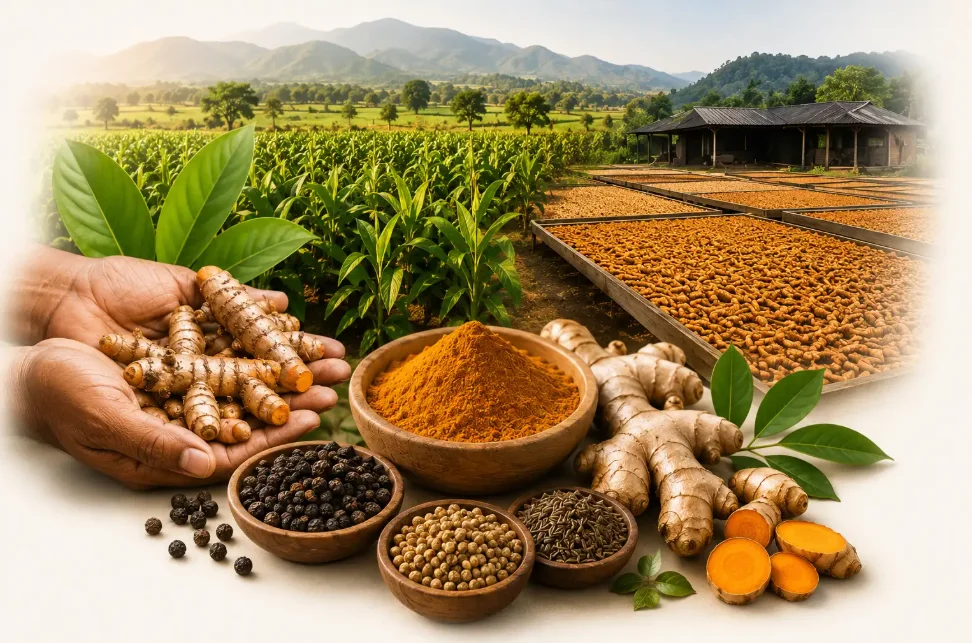
How a supply shortfall can affect availability, specifications and procurement costs before the final harvest is known
A smaller spice crop does not enter the market as a simple reduction in tonnes.
The effects begin much earlier, when weather conditions change production expectations and market participants start reassessing the supply available to them. From farmers and traders to processors, exporters and importers, each stage responds to the changing replacement cost.
For spice buyers, this means that supply pressure can become visible before the final crop size is confirmed.
Get in Touch :-
Weather is one of the earliest signals the spice market watches.
Rainfall quantity matters, but so do its timing, distribution and the stage of crop development. When growing conditions deteriorate in important producing regions, expectations around yield can change before harvesting begins.
India’s 2026 monsoon provides a useful example. Rainfall has remained below normal overall, with significant regional variation. The implications are different across crops and growing regions, but such conditions can lead market participants to reassess expected supply.
That reassessment is often the first stage of a supply shock.
It starts with the crop outlook
Expectations change before physical supply does
Once expectations around production change, participants begin adjusting their inventory decisions.
Farmers may hold better-quality material. Traders become more conscious of the cost of replacing their stocks. Processors reassess inventory coverage and future raw-material requirements.
At the same time, buyers looking for particular origins or specifications may start competing for a smaller pool of suitable material.
This is where expected supply and available supply begin to diverge.
There may still be substantial stock physically present in the country, but less of it may be actively offered into the market.
Why mandi arrivals need to be read carefully
Mandi arrivals provide an important indication of how much material is currently entering the trading system.
However, lower arrivals do not automatically mean that production has fallen by the same proportion.
Lower arrivals can result from a smaller crop, but they can also reflect farmers holding stocks, traders retaining inventory or changes in selling behaviour.
For procurement teams, the useful question is therefore not simply “Are arrivals down?”
It is:
“Why are arrivals down, and what does that tell us about material currently available for purchase?”
That distinction becomes particularly important when prices are moving quickly.
A smaller crop can change the quality mix
The impact of a smaller crop is also visible in what is available within the total volume.
When supply tightens, competition may increase for higher-grade fingers, particular origins, higher-curcumin material, preferred colour profiles or processing grades with consistent characteristics.
This can create a very different problem for a food manufacturer or spice processor.
The market may still have plenty of tonnes available, while the specific material required for a particular application becomes harder to source.
For procurement, availability therefore has two dimensions: volume and specification.
The second can become constrained even when the first does not appear particularly tight.
The cost then moves through the supply chain
A higher raw-material cost does not stop at the mandi.
The trader faces a higher replacement cost. The processor faces higher raw-material and inventory costs. The exporter then procures at a higher level, which can eventually feed into the importer’s landed cost.
Each stage absorbs part of the change.
By the time an international buyer receives a revised quotation, the original agricultural supply pressure may already have passed through several layers of the supply chain.
This is also why comparing today’s quotation only with yesterday’s price can sometimes miss what is happening underneath the market.
Why procurement can feel the pressure early
Commodity markets continuously adjust to available information.
Weather conditions, crop estimates, arrivals, inventories, export demand and replacement costs all contribute to how participants value the material currently available.
The sequence can therefore look like this:
Weather uncertainty → production expectations → availability → replacement cost → market price
The final harvest figure is only one point in that process.
Waiting for complete harvest data can provide greater certainty about production, but by then some of the supply pressure may already have appeared in procurement costs or the availability of specific grades.
What should procurement teams watch?
The objective is not to predict exactly where a spice price will trade.
It is to identify supply pressure early enough to plan around it.
For an international spice buyer, that means watching several indicators together:
- Crop conditions across key producing regions
- Mandi arrivals and their direction
- Carry-forward inventories
- Availability of required grades and origins
- Origin-specific price movements
- Domestic and export demand
- Replacement costs for traders and processors
No single indicator provides the complete picture.
The value comes from understanding how they interact.
The bigger procurement lesson
A smaller crop can affect far more than the headline commodity price.
It can change when material becomes available, which specifications are accessible, how much inventory participants are willing to release, and what it costs to replace that material.
For spice procurement, this makes market intelligence particularly useful when it moves beyond reporting prices and begins connecting the dots between crop conditions, supply behaviour, availability and cost.
The important question is not simply where prices are today.
It is what is changing underneath the price — and how far that change has already travelled through the supply chain.
VT Agro Foods | India Spice Market Intelligence
Tracking developments across India’s spice markets with a focus on supply, quality, availability and procurement implications.